Toxicity of radioactive waste
The composition of radioactive waste is known: it consists of different types of radioactive isotopes. Based on this, it is possible to calculate the decay rate of the radioactivity for each waste type. As a result of radioactive decay, the toxicity of the waste is reduced and eventually reaches natural levels. How long this takes, varies between the different waste types.
How long must the waste be contained?
After approximately 30 000 years, low-and intermediate-level waste reaches the radiotoxicity of natural granitic rock. The radioactivity of spent uranium fuel reaches natural levels after around 200 000 years.
During this period, radioactive waste has to be isolated from our environment. Disposal in geologically stable rock formations ensures the safe containment of the waste for a sufficiently long time period – this fact is recognised worldwide. For this reason, the waste has to be disposed of in a so-called deep geological repository.
How to avoid excessive radiation exposure
Radioactive substances emit ionising radiation that can break up chemical compounds. The effect radioactive substances have on human health is greater when they are ingested than when they impact the body externally. Ingested radioactive substances decay in the body and can modify the surrounding cell tissue. Excessive radiation exposure (i.e. a high radiation dose) can therefore directly impact the organs and lead to long-term damage such as cancer.
Safe containment using barriers
In a deep geological repository, the waste is enclosed by a multiple safety barrier system. This consists of:
- waste containers
- tunnel backfill and
- the surrounding rock
These barriers prevent unacceptable amounts of radioactive substances from being transported by the water to the earth’s surface. A repository is therefore ideally constructed in low-permeability rock.
Strict protection objectives in Switzerland
A deep geological repository has to ensure the permanent protection of humans and the environment, i.e. long-term safety. To this end, the authorities have specified protection objectives and protection criteria. At no time may the release of radionuclides from a sealed repository result in an excessive radiation exposure to humans. Safety requirements specify a protection criterion of 0.1 millisieverts annually. This is equivalent to less than one fiftieth of the total annual radiation exposure in Switzerland.
Using safety analyses, Nagra’s scientists have been able to demonstrate transparently that the multiple safety barrier system can meet these protection objectives. The barriers effectively retain almost all radionuclides over a long time period. Even when based on very pessimistic assumptions, all calculated dose values were well below the protection objective of 0.1 millisieverts per year.
How rapidly does the waste from nuclear power plants decay?
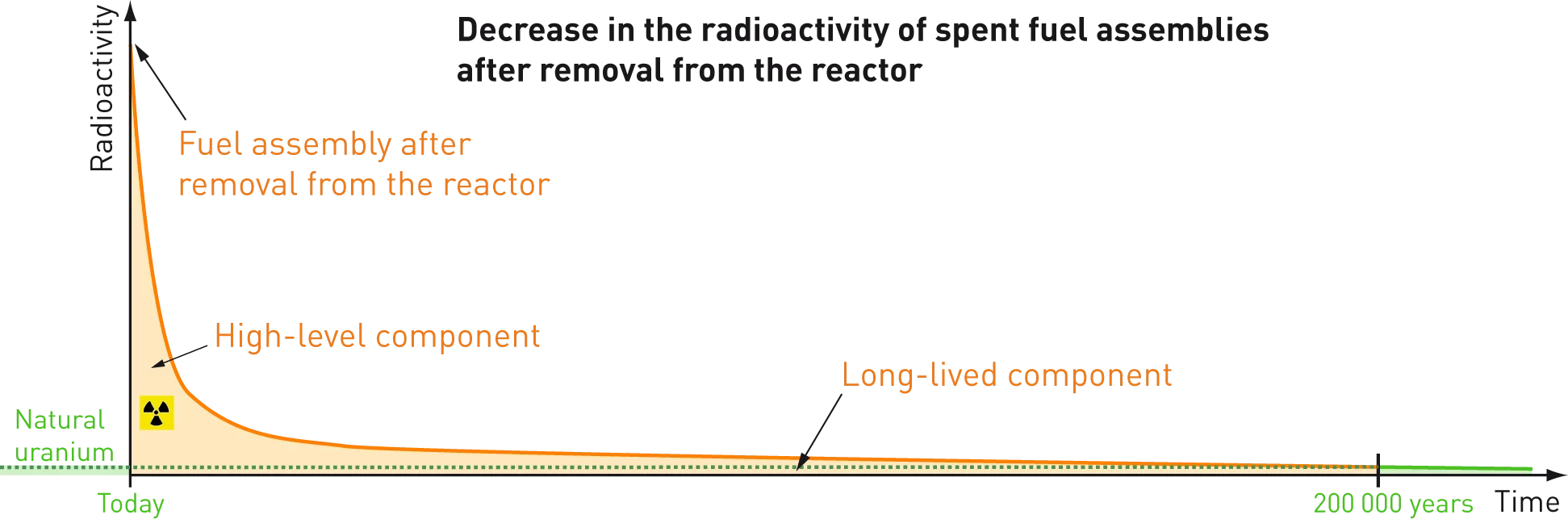
After a period of 200 000 years, the radioactivity of spent fuel assemblies from nuclear power plants will have decayed to the natural radiotoxicity level the uranium ore originally had when it was mined.